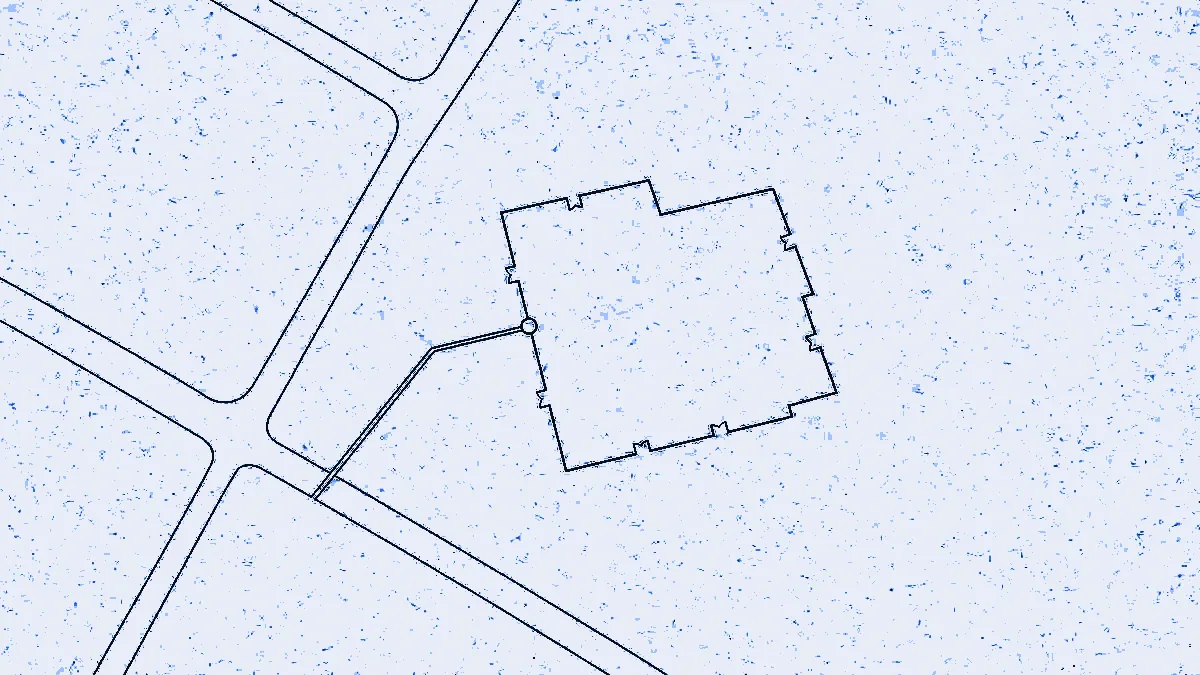
Routes that end at the door, not the middle of the building
Since 20 November 2026 MapMap can return a place's doors and end a route at the right one. Add include=entrances to a place lookup and each result lists the entrances mapped in OpenStreetMap and tied to that place on evidence; name the place on POST /route and the route ends at the best door for the way you are travelling, with a plain sentence saying which door and why.
Why is a place's coordinate the wrong destination?
Because for a station, a supermarket or an office block the point we hold is usually somewhere inside the building, not at a way in. Routing to it ends you on whichever road happens to be nearest that point, which can be the service yard at the back. Someone walking wants the door, a driver wants the door nearest a road they can use, and a wheelchair user wants the step-free one. One coordinate cannot be all three.
What does an entrance answer look like?
A list of doors on the place, each with where it is, what kind of door the map says it is, and what tied it to the place. This works with no key, because reverse geocoding is on the keyless demo lane:
curl -s "https://api.mapmap.ai/geocode/reverse?lat=51.53384&lon=-0.10738&kinds=poi&limit=1&include=entrances"
Trimmed to one door, the Waitrose it finds answers:
{
  "entrances_index": "loaded",
  "features": [{
    "properties": {
      "id": "osm:w119438298:poi",
      "name": "Waitrose",
      "entrances": [
        {"lon": -0.1070651, "lat": 51.533925200000006, "kind": "yes",
         "wheelchair": null, "access": null, "door": null,
         "osm_id": "osm:n1345642635", "source": "osm",
         "confidence": "high", "basis": "own_outline"}
      ]
    }
  }]
}
The same include=entrances works on GET /geocode, GET /geocode/retrieve and GET /v1/places/in-view, and GET /v1/places/{id}/entrances lists the doors of one place by its id. Without the parameter every response is exactly what it was before, and asking for entrances does not change what a request costs.
How is a door tied to a place?
Only on evidence the map gives, and each tie says which evidence it was:
basis | confidence | Evidence |
|---|---|---|
own_outline | high | The door is a point on the place's own building outline |
stop_area | high | A public transport stop area lists the door and exactly one station |
address_match | high | The door's house number and street equal the place's, on the building the place is in |
sole_occupant | medium | The place is the only place in a building, and the building's doors do not point elsewhere |
Where the map does not say whose door it is, it is tied to nobody. A door two buildings share, the doors of a shopping centre with many shops inside, and a terrace mapped as one building are all refused rather than guessed. confidence grades the tie between door and place; it says nothing about whether the door is open.
How does a route pick the door?
Name the place with place_id on the last location, or send arrive_at, and the destination moves to the best door before the route is computed:
- Never a door you cannot go in by. Emergency exits, exit-only doors and doors mapped private are listed but never chosen.
- Public doors first. Service and garage doors are chosen only when nothing public is tied to the place, or when you ask for one with
entrance_kind. - Step-free when asked. With
arrive_at.wheelchair: true, or a wheelchair pedestrian route, a door mappedwheelchair=yeswins where one exists, and a door mappedwheelchair=nois never chosen. - By car, the door nearest a road the vehicle can use, placed against the road network by the routing engine. On foot or by bike, by kind and then distance.
The answer gains an arrival block with the door chosen, how far the destination moved and a reason such as "main entrance, ranked first of 2 usable by kind then distance from the previous waypoint". The same arrive_at works on navigation sessions, where every reroute heads for the same door, and on the MCP server's route, start_navigation and place_entrances tools.
How often is there an answer?
It depends heavily on the kind of place. We measured on 20 November 2026 against a UK OpenStreetMap extract of 30 October, on London, Brighton, Leeds and Cambridge:
| Places | With at least one tied door |
|---|---|
| London stations | 74 % |
| Supermarkets | 6 to 21 % |
| Offices | 3 to 11 % |
| Hospitals | 0 to 8 % |
London stations do well because their OpenStreetMap stop areas list the station's entrances. Hospitals do badly because a hospital is mapped as a site with the doors on the buildings inside it, and no rule ties a building's doors to the site. In a hand check of places against the OpenStreetMap geometry, no door was listed under a place it did not belong to; 15 places had their doors listed correctly, 10 correctly had none, two had some of their doors and two with mapped doors got none, in buildings the rules refuse to guess about.
What does it not do?
- An empty list never means no entrance. It means no door is tied to the place. Most places have no entrance mapped at all, and an assistant passing this on should say "no door is mapped", never "it has no entrance".
- Every door is a mapped door. All of them come from OpenStreetMap (
source: "osm"). We do not estimate doors today, although the response has room for it. - It never fails a route. When no door can be chosen, the route goes to the destination you sent and
arrival.appliedisfalsewith the reason. - A missing
wheelchairtag is unknown, not step-free. plan_daystops end where they are placed. Multi-stop day plans do not move stops to doors.- A self-hosted deployment needs the entrance side file built with its geocode index, or it answers that entrances are not configured.
Try it
Run the keyless request above, then route to the door with a key by putting the place's id on your last location. The full reference, including the web SDK's getPlaceEntrances in @mapmap/maps 0.26.0, is in the place entrances documentation. For place results described from where the user is standing, see egocentric place results. Doors and places © OpenStreetMap contributors.