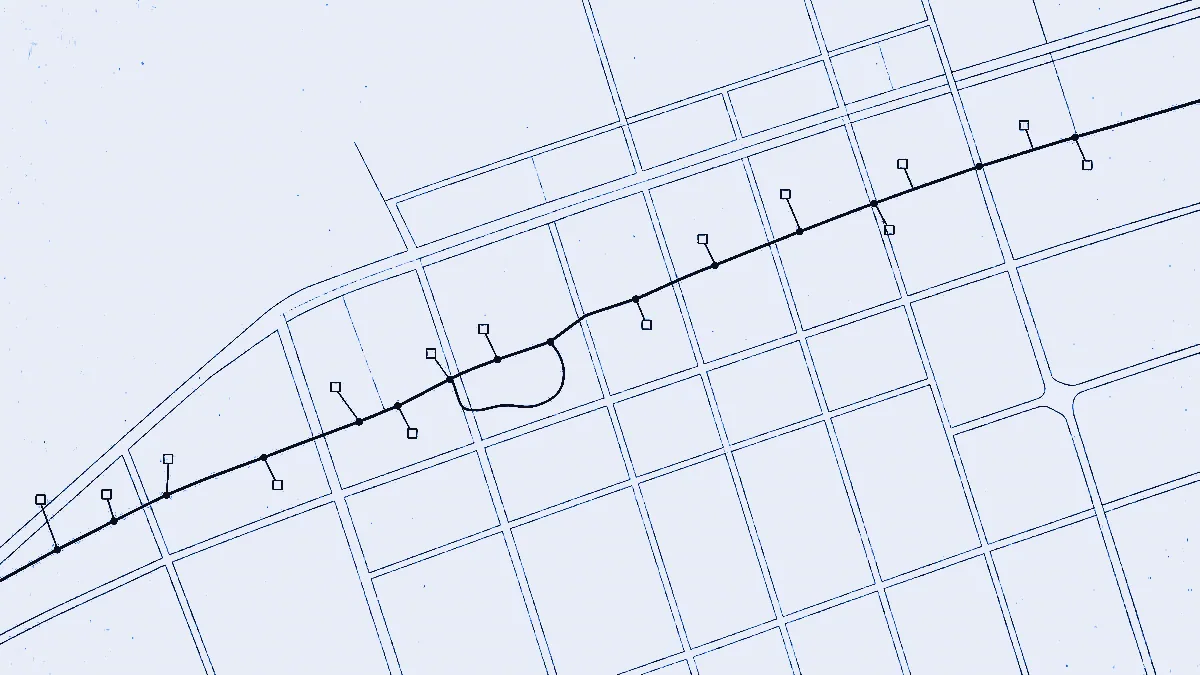
Turn-by-turn guidance for clients with no navigation engine
A voice assistant, a pair of smart glasses or an AI agent can now guide someone turn by turn without running a navigation engine of its own. Open a navigation session with POST /v1/navigation/sessions, post each position as it arrives, and the gateway answers whether the traveller is on the route, off it, rerouted or arrived, with the next instruction to say.
Who is a navigation session for?
Clients that can report a position but cannot run guidance. A phone or car app should keep using the mobile SDKs, which run turn-by-turn guidance on the device, offline, with no request per position. A watch, a wearable, a robot or an assistant holding a conversation has no such runtime, and until now it had to call POST /route and work out for itself when the traveller had missed a turn. A session moves that work to the gateway, running the same guidance engine the mobile SDKs run on the device.
How does a session work?
Four routes, all on the hosted API since the week of 23 November 2026:
| Route | What it does |
|---|---|
POST /v1/navigation/sessions | Computes the route and opens a session: session_id, route summary, first instruction |
POST /v1/navigation/sessions/{id}/progress | Takes one position fix and answers a state and the next instruction |
GET /v1/navigation/sessions/{id} | Reads the session back without posting a fix |
DELETE /v1/navigation/sessions/{id} | Ends it and drops what it held |
Every progress answer carries one of five states: on_route, off_route, rerouted, arrived or lost_position. When instruction_changed is true the client reads next_instruction aloud; otherwise it says nothing new. Send heading_deg with a fix and the instruction gains a direction phrased from where the traveller is facing, such as "to your right, a few steps away".
A session opens with the same options a route takes: costing (auto, truck, bus, motorcycle, motor_scooter, bicycle or pedestrian), a truck or ADR profile, landmark phrasing on turns, language and units. It can also end at a building's door rather than its middle, with the same arrive_at that place entrances added to POST /route, and every reroute heads for the same door.
When does a session reroute?
Only once a departure is confirmed. A reroute needs three consecutive off-route fixes spanning at least 5 seconds, so one stray GPS fix never sends anyone a new route. At most one reroute is computed every 10 seconds and 50 in a session, and the new route starts facing the way the traveller is heading, so it carries on forward rather than turning them round.
Fixes that cannot be trusted never move guidance on. Each is answered lost_position with a reason:
fix.reason | Meaning |
|---|---|
low_accuracy | The fix's stated accuracy is too poor to use |
implausible_jump | Further from the last fix than this mode of travel could go in the time |
far_from_route | Too far from the route to belong to this journey |
out_of_order | Its timestamp is not after the last accepted fix |
after_arrival | The journey has already arrived |
When a fix is refused, numbers_current is false, which tells an assistant not to announce the remaining distance as fresh.
What does a session keep?
The route and the last accepted fix, nothing else. The session needs the last position to judge the next one and to reroute from it. It keeps no trail of earlier positions, and no position is written to a database, to disk or to a log. Every answer carries a privacy sentence saying so, which a client can show as it stands.
What does it cost?
Opening a session is metered as one call, like a two-point route. Progress is one call per started block of 30 progress requests in the session, plus one call for each reroute, billed on the request that computes it. Reading and ending a session are free. Truck costing or an ADR profile makes the session Premium, as it does on POST /route. The unit rules are in /pricing.json.
What does it not do?
- Sessions do not survive a restart. They live in the memory of the gateway that opened them. A deploy or a restart drops them, and the client gets a
404and should open a new session from where the traveller is now. - Two hours idle and it is gone. Every progress call and every read resets the clock;
expires_atsays when it will run out. - 100 live sessions per account. One more answers
429withnav-session-limit. End sessions withDELETErather than leaving them to expire. - No offline. Every fix is a request. With no signal there is no guidance, which is why phone apps should navigate on the device.
- Times are estimates.
remaining_sandetaare the engine's estimates; on routes in Great Britain they include the typical junction delayPOST /routeadds. - Keyless use is shared. Through the hosted MCP server without a key, every keyless caller's sessions sit on one shared account, so its session cap is shared too.
Try it
The hosted MCP server connects with no key, and its start_navigation, check_navigation_progress and end_navigation tools wrap the session routes. On 25 November 2026 we opened a walking session across central Brighton:
{"name": "start_navigation",
 "arguments": {"origin": {"lat": 50.829, "lon": -0.141},
               "destination": {"lat": 50.8226, "lon": -0.1371},
               "costing": "pedestrian", "language": "en-GB"}}
It answered a 1,036 m route in 13 steps with the first instruction "Turn left onto the walkway." and an idle_ttl_s of 7200. One fix posted with heading_deg: 180 and accuracy_m: 5 came back on_route, accepted, with the next turn "to your right, a few steps away" and 1,029 m to go. end_navigation answered that the route and the last position were dropped.
With a key, the REST routes take the same fields. The web SDK wraps them as startNavigationSession and sendNavigationProgress in @mapmap/maps from 0.26.0, and the published API clients carry them as typed methods. Every field, state and error is in the navigation sessions documentation. Routing data © OpenStreetMap contributors.